

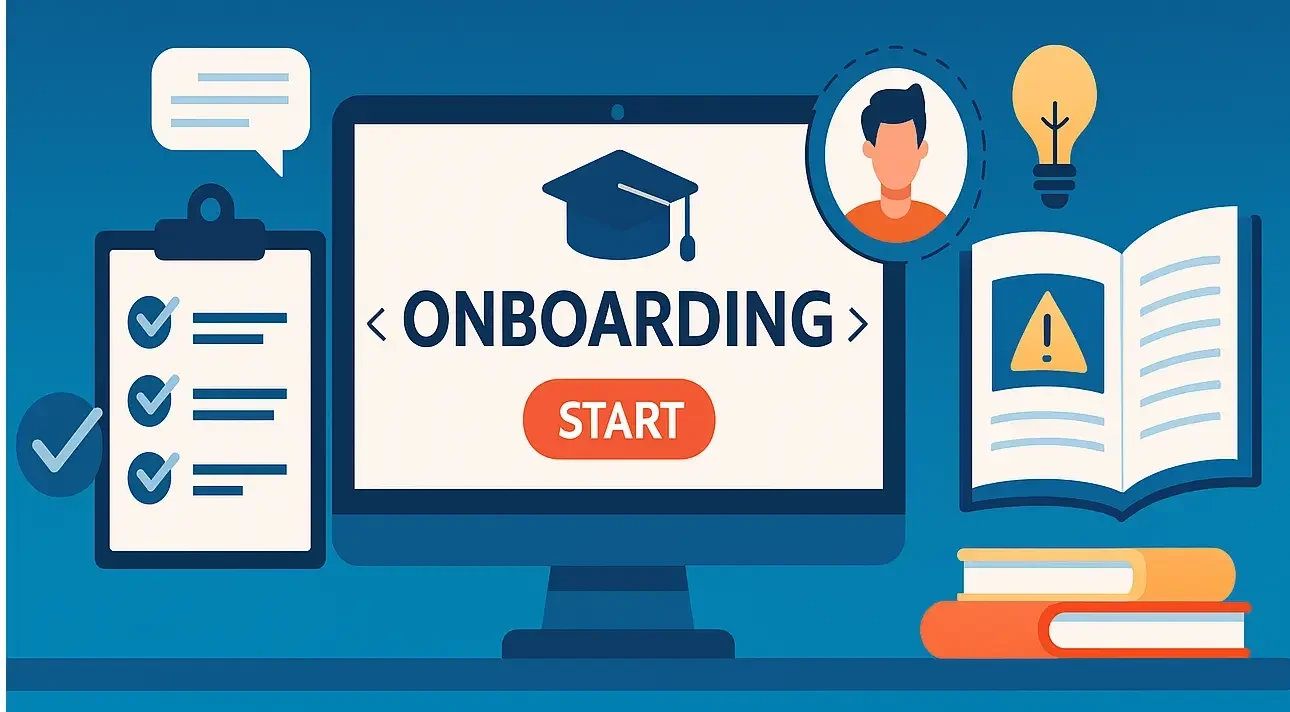
Welcoming a new employee is a decisive moment: motivation, sense of belonging, understanding expectations, and building autonomy all take shape in the first weeks. Yet many businesses still improvise this critical step, with a real risk of early departure.
🎯Why rethink onboarding?
Onboarding is more than paperwork and coffee chats. It is the engine of engagement, productivity, and long-term retention.
- 📉Only 12% of employees feel they receive a solid onboarding experience.
- 📈89% report higher engagement when their first weeks are structured.
- 🙂A great onboarding makes people 2.6× more likely to enjoy their job.
- 🧭78% would stay longer if they saw a clear career path from day one.
💸The hidden costs of winging it
An improvised onboarding can cost several thousand dollars per employee: errors, a slower ramp-up, disengagement, and new hires. By contrast, a structured onboarding can improve retention by up to 82% and productivity by 70% (Brandon Hall Group).
🌍A transformed context
- 🏠Remote work limits informal learning and natural socialization.
- 🧠New generations ask for purpose, clarity, and autonomy.
- ⚙️Digital tools make an engaging, flexible onboarding experience possible.
As a result, traditional onboarding journeys are no longer enough. You need a structured, human approach adapted to your reality.
🧩What is interactive onboarding?
Interactive onboarding is a guided, personalized digital journey that a new employee follows at their own pace with intelligent support.
Concrete examples:
- Loom welcome videos or focused training videos
- Illustrated Notion or Google Sites modules
- Typeform quizzes to verify understanding
- ClickUp or Trello boards to simulate progress
- Step-by-step tutorials with Scribe or Tango
⏱️What pace should you adopt?
There is no universal duration, but one thing is clear: the more structured and progressive the onboarding is, the better the results.
High-performing businesses invest in a journey lasting several weeks:
- Days 1 to 5: cultural immersion, discovery of the tools, technical setup, and introductions to the teams.
- Days 6 to 15: process training, job responsibilities, and mentoring.
- Week 3+: growing autonomy, regular follow-up, and assessment of the integration.
Many organizations even offer 30 to 60 hour bootcamps spread over two or three weeks.
It is not wasted time. It is an investment that makes new hires faster, more autonomous, and more engaged.
“Train people well enough so they can leave. Treat them well enough so they don’t want to.”
Richard Branson
💡The key benefits of interactive onboarding
- A consistent experience: every new hire receives the same level of information and follow-up.
- Time saved for managers: less repetition and more targeted support.
- Faster autonomy: new talent becomes useful more quickly.
- A stronger employer brand: the business appears structured, welcoming, and professional.
- Better retention: good onboarding drastically reduces early departures.
🛠️Your onboarding toolkit
| Objective | Recommended tools |
|---|---|
| Build a knowledge base | Notion, Confluence, Slite |
| Share explanatory videos | Loom, Vimeo, private YouTube |
| Create quizzes and assessments | Typeform, Tally, Google Forms |
| Simulate a training journey | ClickUp, Trello, Notion |
| Document processes | Scribe, Tango, Process Street |
✅Quick diagnostic
Review your current journey. If a statement does not apply yet, it is an opportunity for improvement:
- A complete welcome email is sent before day one.
- Workstation, accounts, and tools are ready upon arrival.
- The company story, mission, and values are presented clearly.
- Core tools are explained and practised hands-on.
- Expectations and objectives are aligned early.
- Regular check-ins are scheduled to answer questions.
- Company culture is shared through mentors or activities.
- Essential resources are centralised and easy to find.
- The journey includes interactive, engaging content.
- Impact is measured through feedback and metrics.
If several elements are missing, it is time to rethink your onboarding so you can offer integration that matches your ambitions.
🚀Ready to create your onboarding program?
At 2T Conseils, I design interactive journeys aligned with your tools, your tone, and your business objectives.
A well-integrated employee is more autonomous, happier, and more productive.